On August 8, 2025, Sam Altman did an interview with Cleo Abram on her YouTube series Huge If True. Around that time, I was listening to this and similar ones where he talked about new software and what it was going to allow people to build.
He said:
"It is probably possible now to start a company, that is a one-person company that will go on to be worth more than a billion dollars, and more importantly than that, deliver an amazing product and service to the world, and that is like a crazy thing."
He shared variations of that idea. Basically how AI empowers individuals to turn ideas into reality on their own, and how one person could now build something that used to require hundreds of people.
I remember listening to that section while I was at work. Around that time there were some big breakthroughs happening. At the time, I thought he was referring to just the coding features inside ChatGPT, since I had already been using those for a while and knew they had made some big upgrades.
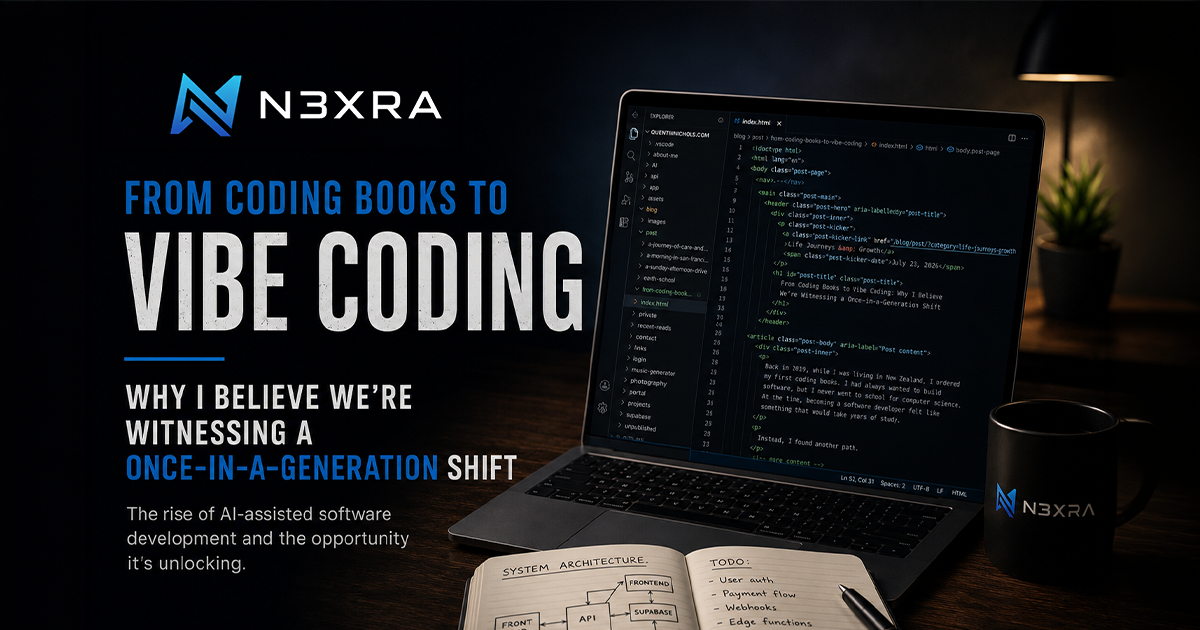
To have a little more context, back in 2019, while I was living in New Zealand, I paid to have some coding books sent over. I still have them. I am literally looking at them right now as I write this. They are HTML and CSS: Design and Build Websites and JavaScript and jQuery: Interactive Front-End Web Development by Jon Duckett.
I went through the HTML and CSS along with Photoshop and some Adobe apps and learned how to build a homepage. It was not interactive or anything. It was literally just the homepage and its structure. That took me a little over a week after work to finish.
I have also been really tired of paying subscription fees. I manage the Ruth Obenchain Recreation Center, and we just do not have the funds to keep paying for everything.
I am talking about transactional fees, apps, smart-home applications, heater management, texting costs. It all felt expensive.
So I found AppSheet, which uses Google Sheets data and basically treats everything like a file structure and data manager. It tells the system how to interact and gives you a simple visual. You can actually do a lot with it.
I ended up maxing it out. I built internal scripts and bots that ran.
We have an Ecobee smart thermostat at the gym, and I created a custom script with API keys and access tokens that refresh. That turned out to be a bigger deal than I expected, because the token constantly has to refresh. It was pretty complex, but I built it. Early on I might have even had Snapchat AI help me, and later ChatGPT helped me learn how to code it better, but it was still a lot of trial and error.
Then I used Voice Monkey so when a URL was triggered inside AppSheet from a sign-in record, lights could turn on and off and all kinds of smart-home automations would run. So we had sign-ins activating lights and even billing heater use.
We also used SimpleTexting for texting. It worked well but cost quite a bit. Since we already had everyone's info in Sheets, I figured out how to send messages internally by selecting accounts. That worked for a while and was free, until they shut it down. After that, I moved to a small pay-as-you-go setup that I just personally pay for. It is cheaper and I have control.
That whole process was kind of my introduction to coding.
And I say coding because there really are some pretty advanced formulas just to get everything to communicate and line up the right way. You are basically learning how to make data talk to other data. AppSheet even has this diagram where everything connects like a mind map. That is honestly how I picture it in my head. Like spider webs of connections.
So when Visual Studio Code came along and I started using OpenAI Codex, that is when I realized what Sam Altman actually meant.
Like I said, I built a whole website in about 70 hours. And I am not joking. I really think it would have taken a couple thousand hours without these tools.
After that, I got really curious about data itself. All these files are really just data files that communicate. So I wrote a script to extract all the text out of them and organize it.
I started researching AI heavily and learned about large language models. I realized I could not build one. That costs billions of dollars and massive resources. But I also realized they do not really do anything until you give them data and tell them what to do with it. And you do not send everything, because you are basically paying the power bill to run those computers. You just send the small piece you need.
Once I understood that, everything clicked.
I built a script that scraped the site data. It took a lot more fine-tuning than I expected because we wanted it to stay only within our own data. Then I built an AI for my personal site in about an hour, and it performed so well that I replaced most of the older system with it. Within another hour, Ask Bly AI was running almost exactly how I pictured it, with text-to-speech and everything.
Now I just see potential everywhere. Literally the only thing separating me from any idea I can imagine is time.
I also have a lot of friends earning good income on TikTok right now. One friend paid off his house, built up savings, and has been spending time in Austin, which I honestly think might be my favorite city in the world. I am jealous about it.
The funny thing is, if I dedicated a little time to TikTok, I think I could probably replace my income at Trees, maybe even more, which would give me more time to code.
But I have been so fascinated with coding that I have not really given TikTok any time at all. I always have new ideas and I cannot seem to step away from learning and building.
So this is really just an update on where I am at. My fascination with all of this and my excitement for what feels possible next.